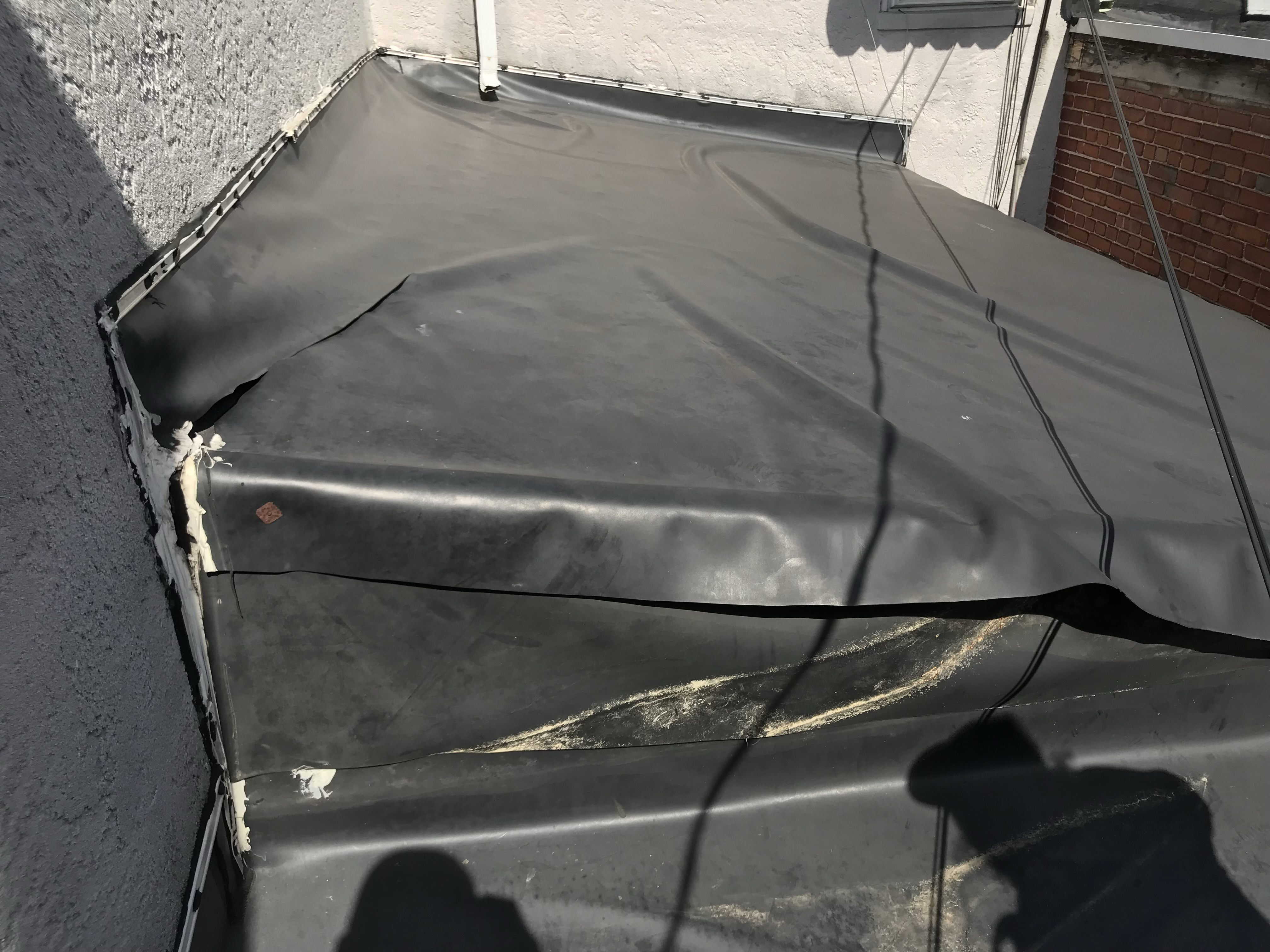
EPDM is good rubber. It goes on black, bakes in the sun for fifteen or twenty years, and by the time most owners start asking questions, it looks terrible: chalky, gray-streaked, seams lifting at the corners. The question we get on almost every one of these roofs is the same. Coat it or replace it?
We sell coatings, so you'd expect us to say coat it. But a straight answer needs a framework, not a sales pitch. Here's the one we actually use when we walk an EPDM roof, in the order we check things.
Question 1: is the deck sound?
Everything starts under the membrane. A coating restores the waterproofing surface; it does nothing for the structure. Walk the roof. If it feels solid underfoot everywhere, that's a good start. If sections feel spongy, if there's visible sagging, or if the underside shows staining and rot from inside the building, the deck needs repair or replacement first. A coating over a failing deck is money thrown away, no matter how well it's applied.
Deck problems point toward replacement, or at minimum toward structural repair before anything else gets decided.
Question 2: how much moisture is trapped in the system?
This is the question that kills more coating candidacies than any other, and you can't answer it by looking. Water that got through old leaks doesn't always drain out; it soaks into the insulation and sits there. Core samples and moisture checks tell the real story.
A few isolated wet spots are workable: those areas get cut out, dried, and rebuilt during prep. But when a large share of the insulation is saturated, cutting and patching stops making sense. You'd be rebuilding the roof one square at a time and paying coating prices on top. Widespread saturation means replace. We've told owners exactly that, and we'd rather lose the job than coat over a wet roof that's guaranteed to fail.
Question 3: where are the leaks coming from?
EPDM rarely fails in the open field of the roof. The rubber itself outlasts its own seams. Leaks almost always trace to the details: seam tape letting go, flashings cracking at pipes and curbs, transitions at parapet walls opening up. That failure pattern is exactly what a silicone restoration is built for, because during prep every seam, flashing, penetration, and parapet transition gets polyester fabric embedded in silicone before the field coats go on. The weak points end up reinforced beyond the rest of the roof.
If your leaks instead trace back to punctures everywhere, shrinkage pulling the membrane off its terminations, or water traveling under the membrane from a failure you can't locate, the calculus shifts. Detail leaks favor coating. Systemic membrane failure favors replacement.
Question 4: how old is the membrane, and what shape is the rubber in?
Age alone isn't disqualifying. What matters is whether the rubber is weathered or actually failing. Chalking, gray fading, and surface dirt are cosmetic; that membrane still has structural life left, and a coating locks it in place and stops the UV clock. Rubber that's gone brittle enough to crack, or shrunk hard enough to bridge corners and pull at its edges, is a different story. If you're not sure which you're looking at, our post on the signs a flat roof is a coating candidate goes deeper on what to check.
Question 5: what does the budget timing look like?
Money decides plenty of these calls, and there's no shame in that. Replacement in Pennsylvania runs $10 to $18 per square foot as a capital expense, depreciated over decades. A silicone restoration runs $3 to $7 per square foot, and it's often treated as a maintenance expense, deductible in the year you spend it (confirm with your tax advisor). Full numbers are in our 2026 flat roof coating pricing guide.
There's also the disruption cost that never shows up on a quote: a tear-off exposes the building and disrupts tenants for days to weeks. A coating goes on while the building stays open, and most jobs finish in 3 to 7 working days.
A real one: the 18-year-old EPDM in Reading
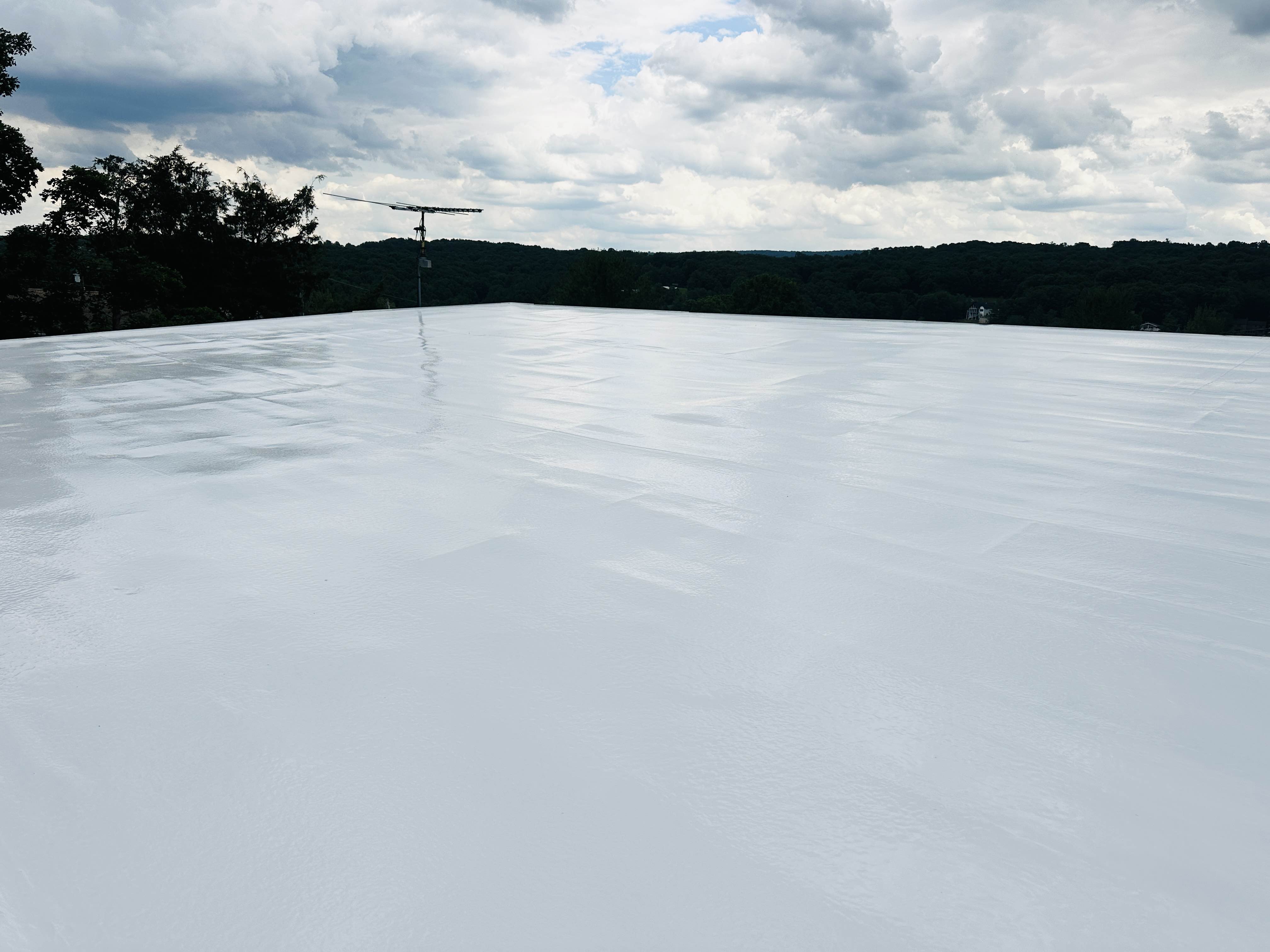
Here's the framework applied to an actual roof. An 18-year-old EPDM in Reading, PA: black rubber gone chalky, leaves collecting on it, seams starting to show their age. On paper, plenty of contractors would have called it done and quoted a tear-off.
Walking it told a different story. The deck was solid. Moisture checks came back workable. The trouble lived where EPDM trouble always lives: at the seams and details, not in the field. So it got the full restoration: deep clean, every seam reinforced with polyester fabric embedded in silicone, then two coats of 100% silicone to manufacturer mil spec. What was an aging black roof headed for a landfill is now a bright white, seamless, warranted system, and when the coating eventually wears down years from now, it gets washed and recoated instead of torn off. The full process is on our EPDM roof restoration page, photos included.
The short version
- Coat it if the deck is sound, trapped moisture is isolated, leaks trace to seams and details, and the rubber is weathered rather than failing.
- Replace it if the deck is compromised, the insulation is broadly saturated, or the membrane itself has failed systemically.
- Not sure? That's what the inspection is for. This is not a decision to make from the ground.
One of the owners will walk your EPDM roof, run through exactly this framework, and give you a straight answer with a fixed-price written quote if a coating fits. If it doesn't, we'll say so. We never sell a coating over a roof that needs to come off.