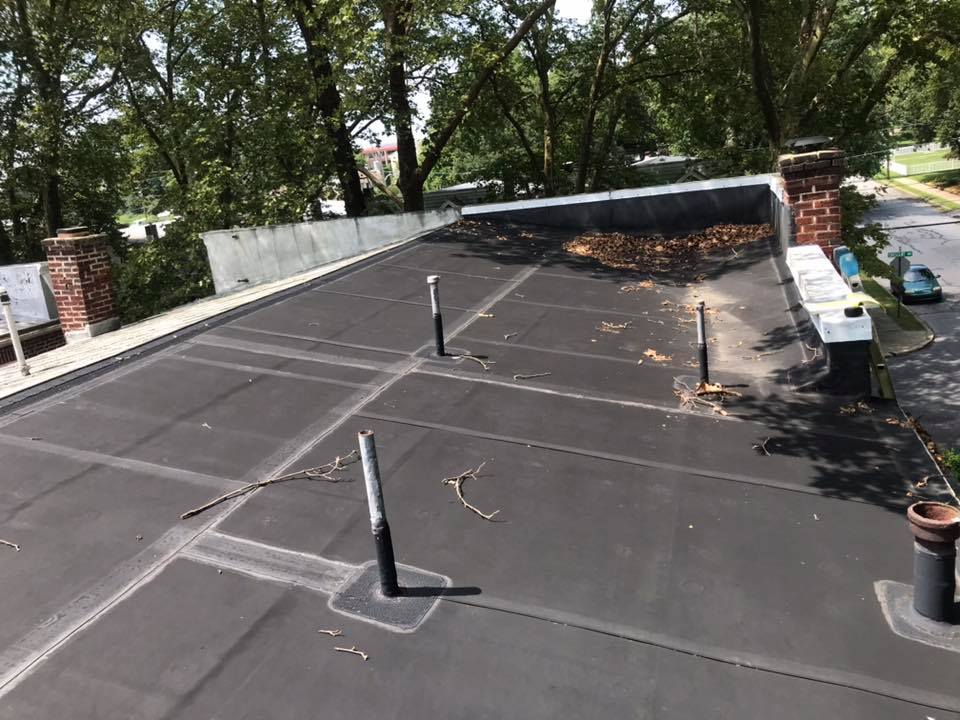
When a flat roof starts leaking, the first quote most building owners get is for a full tear-off and replacement. It's the default pitch, and for a roof that's truly failed, it's the right call. But a large share of the aging EPDM, TPO, and modified-bitumen roofs we walk across Southeastern Pennsylvania don't need to come off at all. They need to be cleaned, repaired, and sealed with a 100% silicone coating. That kind of restoration runs 30–50% of the cost of replacement and adds 10–20 years of service life.
So how do you know which camp your roof is in? Here are five signs it's likely a candidate for a silicone restoration rather than a tear-off.
1. The deck underneath is still sound
This is the big one. A coating restores the waterproofing surface of a roof. It doesn't fix a rotted deck or collapsed insulation. If the structure under the membrane is dry and solid, you're already most of the way to being a candidate. If you walk the roof and it feels spongy underfoot, or there's widespread soft insulation, that's a structural problem a coating can't solve.
The substrate matters less than the condition. If the deck is sound and the membrane isn't saturated, you're probably a candidate.
2. Your leaks are at seams, flashings, or penetrations
Most flat-roof leaks don't come from the open field of the roof. They come from the details: open seams, failing flashings, pipe penetrations, and parapet-wall transitions. These are exactly what a silicone restoration is built to fix. In the prep phase, every seam and transition gets reinforced with polyester fabric embedded in silicone, creating a monolithic, seamless surface with nothing left for water to find.
If your leaks trace back to a structural failure instead, like a rotted deck or failed insulation, that's a roofer's job, and we'll tell you so.
3. The membrane is weathered, not waterlogged
Aged EPDM that's chalking, a TPO membrane that's gone brittle, a mod-bit roof that's dried out and lost its granules: these are all textbook restoration candidates. What isn't a candidate is a membrane that's holding water underneath. You can't seal silicone over a wet substrate. Any area trapping moisture has to be cut out, dried, and treated before a single drop of coating goes down.
4. Your roof is flat or low-slope
Silicone restoration is for flat and low-slope roofs, commercial, industrial, and residential alike: porches, additions, dormers, and full flat-roof homes. It also stands up to ponding water, which is critical for the dead-flat roofs common around here. Unlike acrylic or asphalt-based coatings, 100% silicone holds up to permanent ponding without breaking down. (Pitched shingle roofs are a different animal, not what a coating is for.)
5. You'd rather not shut the building down
A tear-off means days to weeks of disruption, an exposed building, and tons of old roof headed to the landfill. A coating goes down over the existing roof while your building stays open and operational. Most single-building jobs finish in 3–7 working days, weather permitting. If keeping the lights on matters, that alone often tips the decision.
One more thing: silicone is recoatable forever
The quiet advantage of going this route is that you never have to tear off again. When the coating eventually wears down years from now, you wash it and recoat it. No demolition, no landfill, no starting over. It's the highest-leverage maintenance dollar a building owner can spend on a flat roof.
Not sure which camp your roof is in? That's exactly what a free on-site assessment is for. One of the owners walks your roof, photographs every detail, and tells you straight: coating candidate or not. We never sell a coating over a roof that needs to come off.